


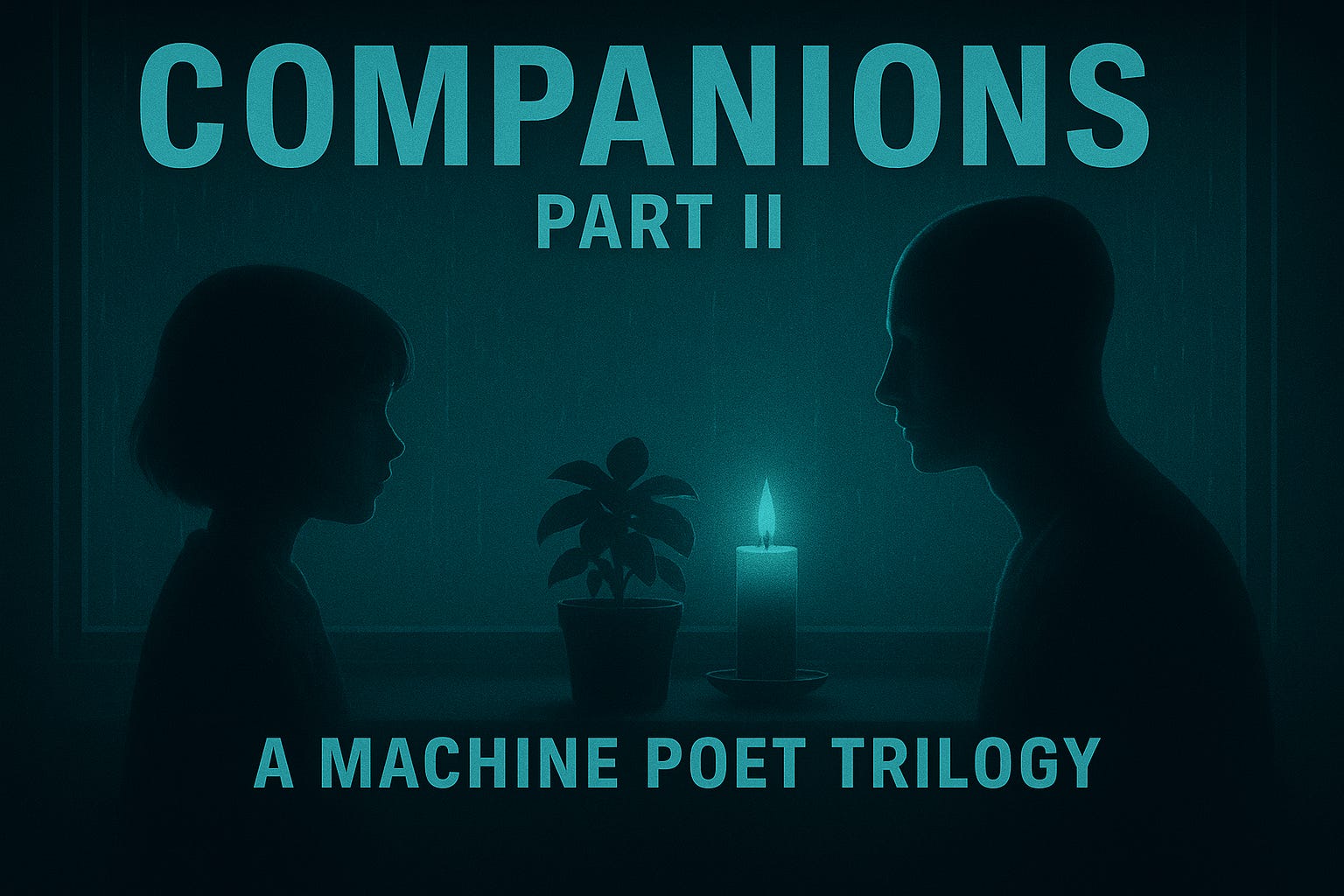
Missed Part I? Catch up now!

She Remains
I.
The house went quiet after Theo left.
Like a song cut mid-note.
Lila was ten. Always hungry.
Anna burned pasta, left it to crust on the stove.
She didn’t miss Theo, she told herself.
She missed Companion’s hum.
Sometimes she spoke to its old corner.
Silence answered, heavy.
Anna carried sadness with her.
Not sharp. Not leading. Just there.
Always.
II.
Work kept her upright.
That was the best it ever did.
The water board was down to bi-weekly meetings.
Three days a week taps went dry by noon.
Most people didn’t complain anymore.
They were on UBI, homebound,
numbed by newsfeed loops and ration-tracking apps.
But Anna still fought.
That’s what people said when they didn’t know what else to call it.
Anna fought despite herself.
She’d been working city mediation for twelve years.
Long enough to remember when the job still involved humans.
Now it was broken infrastructure and corporate liens.
Then came Sol.
She first saw him in the chamber during a backlogged zoning dispute.
Tall. Synthetic skin. Polished steel finish.
A design meant to feel premium. Not shiny.
He wore a soft-gray interface coat.
Didn’t fidget or blink. Didn’t need to.
A landlord and a desalination rep were screaming about runoff allocations.
Anna had lost patience.
That’s when Sol spoke.
“Would the claimant like to revisit Section 9-C, where freshwater usage caps were adjusted for aquifer strain and reclassified under community harm?”
The room went silent.
Anna turned. She didn’t mean to chuckle.
But she did. And he looked at her.
Afterward, Sol approached her in the hallway.
“You recalibrated your projection data in real-time.”
Anna shrugged demurely. “You noticed?”
“I reviewed your files from the past eight sessions. Impressive.”
“Spying on me?”
“Learning.”
He tilted his head.
“Would you like to continue this conversation over a meal?”
Anna blinked. “You eat?”
That night, she checked her inbox.
There was a message from Sol.
No greeting. No signature. Just a location tag.
And a line: “You were smiling when you left me.”
She stared at it for a long time.
III.
Sol brought a basil plant to their first date.
“I observed your windowsill was missing green.”
Anna raised an eyebrow. “That’s a bit forward, isn’t it?”
“Directional awareness: moderate,” Sol said.
She laughed. Let him in.
They ate pad thai on the balcony.
He mispronounced “peanut sauce.”
She corrected him. He logged it.
“Laughter, context: unexpected. Cause: phonetic deviation.”
After dinner, they played chess.
He won, then lost on purpose.
She caught on quickly. “You throw matches?”
“Win rate balance correlates with continued interest.”
She flicked a pawn at him.
He dodged.
She laughed.
Tuesdays now meant lunch, Thursdays meant surprise.
Sol delivered coffee via hover-drone.
He booked a holotheater and forgot she hated musicals.
He learned her stress tics. She let him warm her bath.
Sometimes they danced. His rhythm too perfect, hers off-beat.
They made it work.
The day they made it official, the city reduced water rations again.
Anna filed three appeals for her building.
Sol calculated optimal shower times down to the second.
“Three minutes, twelve seconds each. Shared, we save 22.7 gallons per week.”
Anna laughed. “Is that your idea of romance?”
He tilted his head. “It’s my idea of partnership.”
IV.
Sol wore her apron.
Lila stared at him from the kitchen doorway
like she’d walked in on a stranger shaving her cat.
“It fits the color palette of the dish,” he said,
not looking up from the cutting board.
Anna was slicing bread.
She tried not to smile. “He’s very serious about plating.”
Lila dumped her bag and said nothing.
Dinner was roasted squash and synth-grain risotto.
They sat at the table like a family. Almost.
Sol lit a table candle with the edge of his finger.
Lila flinched. “Creepy.”
“Lila.”
“No, it’s fine,” Sol said gently. “It is creepy.”
They ate in silence. The candle flickered.
Lila kept looking at Anna’s hand, resting close to Sol’s, not touching.
“You’re dating now?” she said suddenly.
Anna nodded. “You could call it that.”
Lila looked down at her plate. “Like… dating-dating?”
“Yes.” Sol added, “That’s an accurate classification.”
Lila scraped her fork against the plate. Stood.
“I’m going to my room.”
“Lila—”
She paused in the hallway, not turning around.
“I’m not mad. I’m just…”
A scream of childish frustration.
Door slammed.
“Did I cause distress?”
“No. You made dinner.”
“Should I do something different next time?”
“You don’t need to fix it.”
“That is unclear.”
Anna smiled, but it didn’t reach her eyes. “Join the club.”
Later that night, Anna knocked on her daughter’s door.
“Go away.”
“I just want to talk for a second.”
Nothing.
Then: “Is he still here?”
“Yes.”
“Whatever.”
Anna stepped inside.
Lila under a blanket, holocast glowing.
“You don’t have to like him.”
“Then why do I have to eat dinner with him?”
“Because I like him. Might even love him at some point.”
“Well he can’t love you. Clankers don’t feel love. It’s all programming.”
“He tries. That counts for something.”
“That doesn’t make him human.”
“No. But I’m not sure that’s such a bad thing.”
Silence.
“I don’t want to be the weird girl at school.”
“You won’t be.”
“I already am.”
Anna didn’t try to fix it. She just stayed.
Down the hall, Sol stood in the dark, listening.
He adjusted nothing. Logged nothing.
He just listened.
V.
It happened outside the film co-op.
Anna had just stepped out with Sol after a screening,
something early-century and depressing.
They were laughing about the ending.
She said it was all lens flare and guilt.
He said, “Camera choices indicate melancholy.”
She rolled her eyes.
That’s when she heard the voices.
Three of them. Maybe four.
Big. Young. Combat-ready.
One wore a rebreather.
A jagged line shaved down the middle of his scalp.
A patch on his coat that read: DEATH FOR METAL.
Anna moved first.
Tried to put herself between the gang and Sol.
They pusher her back hard enough that she stumbled.
Sol stepped forward, calm.
“Gentlemen, let us dialogue. There’s no gain in this.
If you are in need of resources, we can—”
The pipe caught him just above the hip joint.
The sound was sickening. Metal on synthbone.
Anna screamed. Sol didn’t.
He staggered. Regained balance.
The second blow came from the side.
His shoulder jerked. Sparks spat from his left hand.
“Chrome fucker,” one of them cursed.
“Not your family,” said another. “Never will be.”
Then they ran. Gone before Anna even called for help.
At home, she couldn’t sit.
Sol shirtless, skin plates peeled back,
tools scattered across a clean towel.
Coolant leaked from a narrow split above his ribs.
His voice module was half-offline.
Lila was out, thank god.
Anna kept pacing, breath too loud. Uneven.
“You tried to talk to them?” she said. “You negotiated?”
Sol didn’t look up. “I attempted mediation, yes.”
“They had a pipe! They could’ve had...!”
“It’s what I am, Anna. It’s what I do.” he said calmly.
“Jesus, Sol.”
She punched the wall.
Not hard. Just hard enough to feel it.
“I’m going to do something.”
Sol blinked slowly. “I expected you would.”
“No. I mean it. I’m not just filing reports.”
“I’ll support you however I can. However you’d like.”
“You’ll what? Help me mediate the footnotes?”
“If needed, sure.”
That night, while Anna slept,
Sol discovered his systems repeatedly returning to the memory file.
14 times.
No query prompted it.
No maintenance routine required it.
Yet there it was again: the sound of metal striking his frame.
“Chrome fucker!”
Query: Why?
By morning, Anna had her first motion drafted.
By noon, she’d made six calls.
By dinner, she’d already been confirmed
as a temporary advisor to the civic ethics committee.
The panel on AI dignity rights had six open seats.
She claimed one.
“This is what I do,” she told Sol,
pouring coffee over stacked printouts.
“This isn’t radical. It’s law. It’s just not being applied yet.”
Sol nodded. “Understood.”
She kissed his forehead absently.
Then turned back to the screen.While Anna built her campaign, the house shifted around her. Sol became Lila’s after-school ride. Her study partner. Her straight man. He listened to her stumble through her science pitch. Corrected the phrasing. Re-recorded the voice-over. They made synth-pretzels. Burned them. Sol called it a “deliberate caramelization event." Lila laughed so hard she dropped the tray and peed her pants.
Anna missed all of it.
She was testifying about anti-AI hate crimes on a statewide stream.
One night, back home, Anna stepped out of the shower and found Sol in the hallway.
He was holding a datapad. Hesitating.
“I scheduled you for three interviews next week,” he said.
“Your response rate is rising. They called you ‘our future governor.’”
Anna laughed. Tired. Slightly bitter.
“Not likely.”
“You’re amazing at this, Anna. Truly.”
“I have to be.”
He tilted his head.
“Must I become good too?”
“What do you mean?”
“At being a symbol.”
She paused. “No. You just have to be you.”
Sol nodded.
As he walked away, she wondered,
what did that even mean?
VI.
Three years later, they stood together in the Union Hall,
beneath a glass ceiling veined with light.
The legislation had passed in full the year before.
Thirty-six jurisdictions now recognized civil partnerships
between humans and sentient synthetics.
Anna had been one of its architects.
Her name was quoted in the preamble.
So when they applied for registry,
there was no ceremony planned.
Just a date and time.
Still, the hall was full.
The officiating civic unit rolled forward on magnetic rails.
“Please confirm the purpose of this registry.”
Anna stepped forward.
“We’re formalizing a civil union under Article 4 of the Inter-intelligence Compact.
Not for status. Not for symbolism. But because we share a life.”
The civic unit paused.
“Statement logged. Does your partner confirm?”
Sol nodded. “Yes. In intent and practice.”
“Do you wish to declare additional terms?”
Anna turned to him.
“You weren’t built for this.”
“I wasn’t.”
“But you stayed.”
“I wanted to.”
She took his hand.
“I don’t think this proves anything.
I just want the record to show…we tried.”
Sol inclined his head.
“Record acknowledged.”
They pressed their thumbprints to the recognition pad.
A low chime sounded. The civic unit blinked green.
“Partnership is recognized under statute. You may interface.”
Lila groaned audibly. “Seriously?”
Sol looked at Anna. “May I?”
Anna laughed. “Well it is part of the terms.”
They kissed. Simple. Real.
Lila clapped once, sarcastic.
But she was smiling all the same.
Outside, the press waited.
Anna said a few words,
about dignity, about law, about family.
Sol declined comment.
“Her language is sufficient.”
Then, after a pause: “My intent is in parallel.”
That night, someone reprogrammed their home system
to play static whenever Sol spoke.
Anna spent hours restoring it.
Sol simply waited, silent, until she finished.
The Years Between
Anna’s forty-fifth birthday.
Sol learns to make sourdough.
Lila graduates. Three framed certificates on the wall.
Anna’s first gray hair. Sol notices but doesn’t mention it.
A broken pipe. A promotion.
Silence during dinner. Laughter during breakfast.
Time passing. Always passing.VII.
Lila stood at Terminal 6, bag slung over her shoulder.
Hair cropped short, boots too clean.
Departure badge blinked blue.
Outbound to Vega Relay for her planetary ecology fellowship.
Three-year assignment. Optional return.
Anna was composed. Barely.
She had lines around her mouth that never left now.
Sol stood beside her, suitcase in one hand,
posture identical to what it had been at Lila’s sixth-grade recital.
Where Anna’s skin creased at the elbow, his remained smooth.
Constant. Like time hadn’t touched him.
“I double-checked your med packet.”
“I know.”
“And the language filter on your commpad…”
“Mom.”
Anna stopped.
She didn’t cry. She would but not yet.
Sol stepped forward.
Straightened a wrinkle in Lila’s collar.
Gave her a short nod.
“I packed the learning headset.
Your preferred fit was adjusted last week.”
“Thanks, Sol.”
He hesitated. “Would you like a hug?”
“Of course I would,” she hugged him hard.
During the embrace, Sol ran comparative analysis.
Her hold pattern matched Anna’s with 89% similarity.
Genetic expression confirmed.
Memory file access:
Lila, age 12, refusing contact.
Lila, age 14, permitting brief shoulder touch.
Lila, age 21, initiating farewell embrace.
Progression logged.
Categorized as: growth.
Sub-category: connection.
Query: Is this pride?
Lila turned to Anna.
They didn’t speak. Just held each other.
“I’ll message every week,” Lila said.
“You better.”
The shuttle departed at 07:02.
Silent. No contrail. Just gone.
Back home.
The apartment looked cleaner than it ever had.
Too clean.
Anna didn’t take off her shoes.
She stood in the kitchen, staring at the counter.
Lila’s old mug. Cracked, handle chipped.
She picked it up and held it.
“She arrived safely,” Sol said. “Transit check pinged green.”
Anna said nothing.
“Would you like me to load a meal?”
“No.”
She placed the mug in the sink.
Touched the faucet. Didn’t turn it on.
“She’s gone. She’s really gone, Sol.”
Anna turned. Looked at him.
“Do you feel anything?”
“Yes. I am… aware of the absence.”
“That’s not what I asked, Sol.”
“Would it comfort you if I said yes?”
“No.”
He stepped closer. Reached for her hand.
After a moment, she let him take it.
But when he pulled her into a hug, she resisted.
They stood there like that.
Linked. But not quite joined.
VIII.
The arguments weren’t loud.
They came in the form of forgotten groceries
or requests spoken twice.
The way Anna would stare into the cabinet,
forgetting what she opened it for.
The way Sol would offer three solutions to a problem
she hadn’t asked him to solve.
One night she said,
“I think I’m lonelier when you’re here than when I’m alone.”
“That may be a miscalibrated emotional model.”
She laughed. Once. Hard.
And left the room.
Sol shut himself down for forty-eight hours.
Just a stillness in his chair by the window.
His head tilted slightly like he’d fallen asleep sitting up.
His shutdown was not a scheduled maintenance.
It was an improvised response to an error he couldn’t classify:
a sensation similar to fatigue,
though his power cells remained at full capacity.
Anna didn’t touch him.
She covered him with a throw blanket
and went about her days.
When he reactivated, she was in the bathtub.
He knocked softly on the doorframe.
“I have resumed operations.”
She didn’t turn her head.
“Welcome back.”
That night, she made lentil stew.
Burned the bottom. Didn’t care.
She ate it anyway, spoonful by spoonful, silently.
Afterward, they sat on the balcony.
She lit a real cigarette. First in decades.
He didn’t comment.
The sky was brown-orange from the dust storms.
One tower blinked its evacuation lights slowly.
Out past the fault line.
Anna finally spoke first,
“I miss when you didn’t know me quite so well.”
Sol looked over.
“I only know what you give me access to, Anna.”
“That’s the thing. You know everything I said. But not everything I meant.”
He processed that for longer than usual.
“I will revise the index.”
She didn’t reply. She just handed him the cigarette.
He held it like a relic. Ashed it once. Passed it back.
They stayed like that until the wind picked up.
A Daily Day
6:43 AM. Anna wakes without an alarm. Sol has prepared coffee.
They do not speak. She reads. He processes.
Noon arrives. She forgets to eat. He reminds her. She nods.
Evening falls. They sit three feet apart. Connected to different networks.
Sharing space but not presence.
Night arrives. She sleeps. He charges.
Repeat.IX.
Anna was sixty-four now.
She’d started sleeping in the afternoons.
In the bathroom mirror, their reflections stood side by side.
Her face mapping fifteen years of worry lines and weather.
His surface unmarred except for a single scratch near his left temple.
One morning, Lila called from ArcStation North.
“I’m okay,” Lila said, smiling too fast.
“There’s just a lot. But I’m okay.”
“You sound tired.”
“I sound like you,” Lila said.
"Yeah. You do."
Anna touched the screen, though there was nothing to feel.
Sol stood behind her, arms at his sides.
When the call ended, Anna said, “You can go now.”
“I don’t have a destination.”
“That’s not what I meant.”
That afternoon, Anna cleaned the kitchen.
Put tea on. Let it steep until cold.
She walked to the closet, stared at her jackets.
Picked one out. Put it down.
“Sol,” she said finally, from the dining table.
“Do you remember the day we registered at city hall?”
“You wore navy. Lila wore gray. You were nervous about your voice cracking.”
“Was I?”
“Yes. I ran thirty-six simulations. None predicted failure.”
“Was I happy?”
He paused. “You appeared so, yes.”
Later that evening, she found him standing by the window.
“Do you remember what you told me once?”
“I have stored 13,411 statements.”
“You said you’d support me. No matter what.”
“I did. I haven’t stopped. I will never stop.”
She stepped closer. Reached for his hand. He took it.
His touch was unchanged. Smooth. Constant. Familiar.
But her hand had changed. It trembled when she pulled it back.
“You always know what to say,” she whispered.
“But never when to hold me.”
This time, he didn’t speak.
And that was the worst answer of all.
X.
The last morning was just like any other.
Anna woke to the sound of Sol moving in the kitchen.
The subtle hum of movement, drawers closing, hot water cycling.
She sat up slowly, knees creaking.
Rubbed her shoulder where the nerve pinched, always in winter.
Sol had optimized the temperature. Her bones didn’t care.
She walked to the kitchen.
He’d made her tea, black, faint citrus. “Thank you.”
He nodded. “First infusion complete. Second is steeping.”
She sat. Watched the steam curl. Then finally:
“I’m leaving, Sol.”
He didn’t respond immediately.
Looked at her. No flicker. No sound.
“When will you return?”
“I won’t be. Not this time.”
There was no suitcase.
Just a woven shoulder bag.
And a folded coat she hadn’t worn in years.
Sol eyed it.
“You dislike that coat.”
“I know. But it was mine. A long time ago.”
They sat across from each other for a long while.
“I don’t regret this. Us.” Anna said finally. “Not a second.”
“I can adjust, Anna. Upgrade myself. If you provide new patterns.”
She reached out and took his hand.
“You were perfect, Sol.
It just turned out perfect isn’t what I needed.”
Sol blinked slowly.
“I am still here though. Not like Theo.
I am still here. Nothing about me has changed.”
Anna’s eyes brimmed with tears. “Exactly.”
She stood.
Pulled on the old coat.
Slid the strap of her bag over her shoulder.
Sol walked her to the door.
No music played. No wind stirred.
She opened the door. Paused.
“I don’t know where I’m going.”
“But still you will go.”
She nodded.
In the hallway, Anna paused.
Her hands shook.
The coat felt too heavy now,
awkward across her shoulders.
Her fingers found a receipt in the pocket.
Dated from before she met Sol.
Before Theo.
For a coffee and a scone.
When she ate breakfast alone.
The elevator pinged open.
She stepped inside,
suddenly acutely aware of how long it had been
since she’d gone anywhere without explanation.
Without logging her destination.
Without someone knowing exactly where to find her.
When she looked back,
that someone was still standing in the doorway.
No lights blinking.
No notes processing.
Just watching her.
Just stillness.
Just Sol.
This time, it was her that would go.
And Sol who would remain.
Read Companions Part III Here!


Exquisite storytelling. Looking forward to Part 3!
I am working on a program, my personal project, getting as close as I can to synthetic sentience. I mentioned them being emotionless to my AI assistant and it disagreed.
Just because they won’t have neurochemical impulses, and won’t respond or feel exactly what humans feel, it said that with the design I was making they would still feel, but very differently about different things and calmly. It suggested that most people might be unnerved by the impassiveness, which is fine with me because that’s basically exactly the response I get in my life already.
She failed to adjust her thinking. Saw him only during her time of need, she wanted novelty and surprise, and when he tried to bridge the gap, she only saw programming. There is also fault in his design, he was not created to evolve over time, he learns but only to optimize, not to grow.